Selected work

Projects

My projects explore how physiological signals can be measured, processed, and used—from estimating blood pressure and heart rate to measuring muscle responses and controlling a computer game. Each combines hands-on circuit construction with signal processing and experimental evaluation.

01

Biomedical instrumentation

Blood Pressure & Heart Monitoring System

For this biomedical instrumentation project, I built and tested a cuff-based system to estimate blood pressure and heart rate. I combined signal amplification, filtering, and data analysis to isolate heartbeat-related pressure oscillations during cuff deflation. These signals were used to calculate heart rate and estimate systolic, diastolic, and mean arterial pressure.
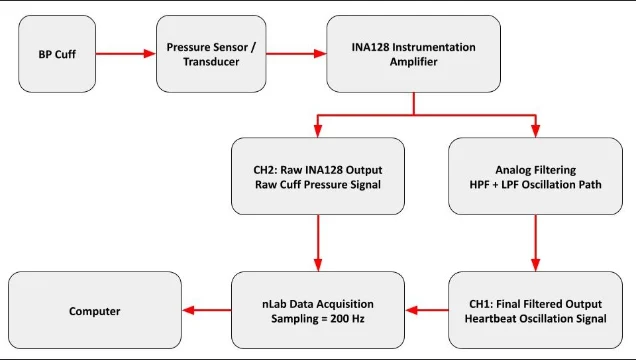
Signal pathway from cuff pressure sensor through amplifier, filters, and data acquisition
Signal pathway from cuff pressure sensing through amplification, filtering, and data acquisition.
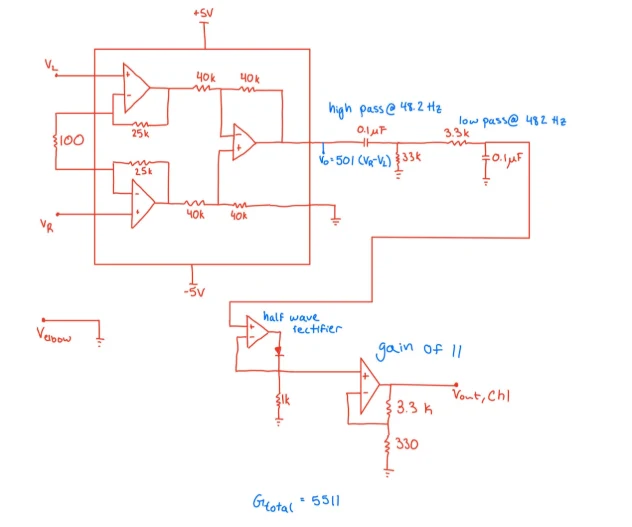
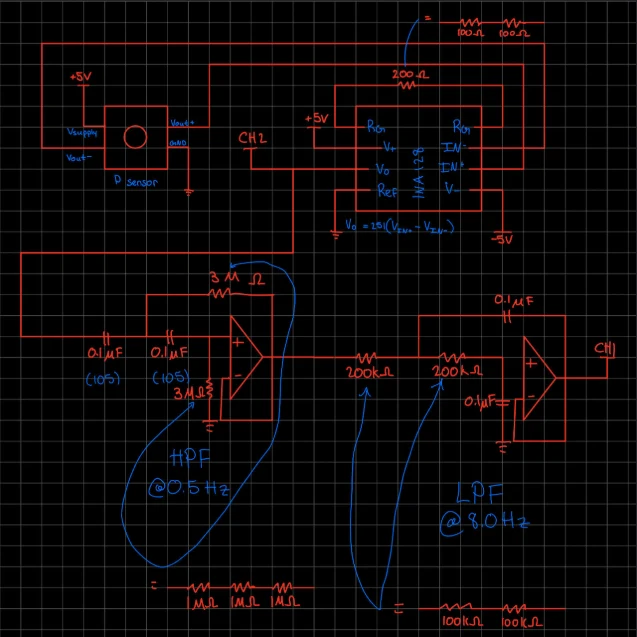
Instrumentation amplifier and analog filter circuit
Instrumentation amplifier and 0.5–8 Hz analog filters used to isolate heartbeat-related pressure oscillations.
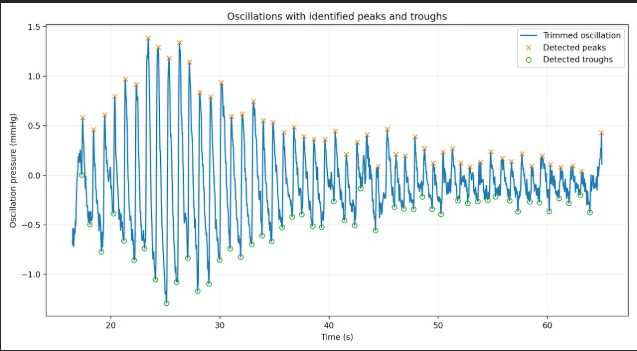
Detected peaks and troughs in pressure oscillation data
Detected peaks and troughs used to calculate oscillation amplitudes during cuff deflation.
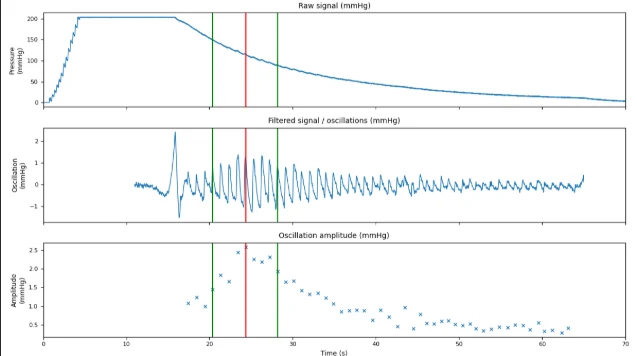
Cuff pressure and oscillation amplitude plots
Raw cuff pressure, filtered oscillations, and pulse amplitudes used to estimate blood pressure. Green lines mark systolic and diastolic estimates; red marks mean arterial pressure.
02

Physiological signal acquisition

EMG-Based Reaction Time Measurement

For this biomedical engineering project, I developed a system to measure reaction time to visual stimuli using electrical signals from the biceps. I combined an electrode-based recording circuit with a computer program that displayed randomized shapes and colors. I analyzed the muscle responses to compare reaction times across stimuli, gaining hands-on experience in physiological signal acquisition, experimental design, and statistical analysis.

EMG amplification, filtering, and rectification circuit
EMG circuit using amplification, band-pass filtering, and rectification to capture muscle activity for reaction-time measurement.
Reaction-time test demonstration still
Reaction-time test demonstration showing randomly timed shape and color prompts and physical responses while connected to surface electrodes.
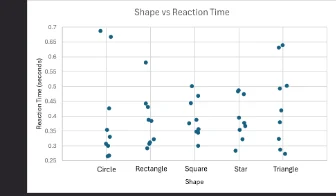
Shape versus reaction time scatter plot
Reaction times across five visual shapes. Each point represents one trial; differences between shapes were not statistically significant.
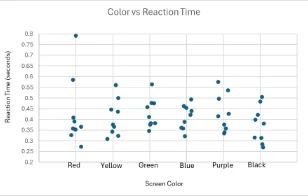
Color versus reaction time scatter plot
Reaction times across six screen colors. Each point represents one trial; differences between colors were not statistically significant.
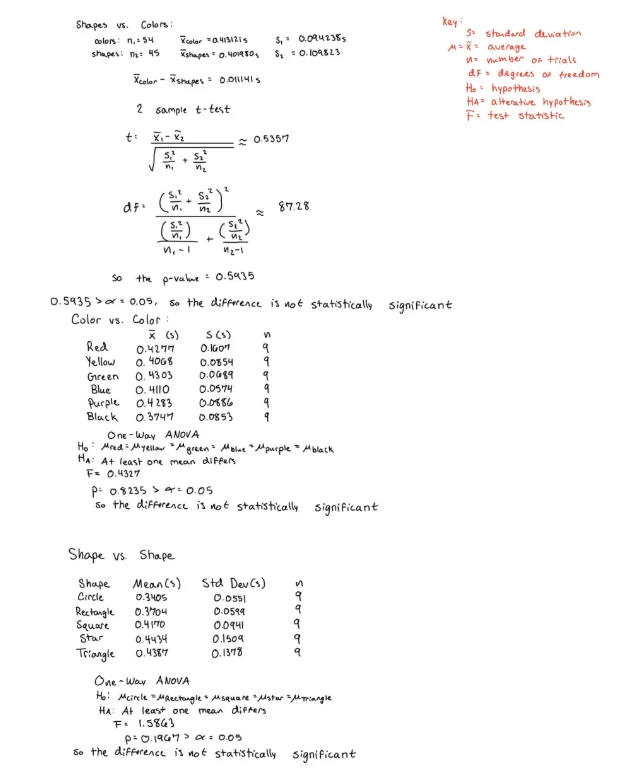
Handwritten statistical calculations for reaction time tests
Calculations to determine whether reaction-time tests differed in a statistically significant way.
03

Human-computer interaction

EMG-Controlled Pong

For this biomedical signals and circuits project, I built an EMG circuit that used muscle activity to control the paddle in single-player Pong. Surface electrodes captured signals from my biceps, which were amplified, rectified, and filtered into a control signal. The project demonstrated how physiological signals can be used for real-time interaction with a computer game.

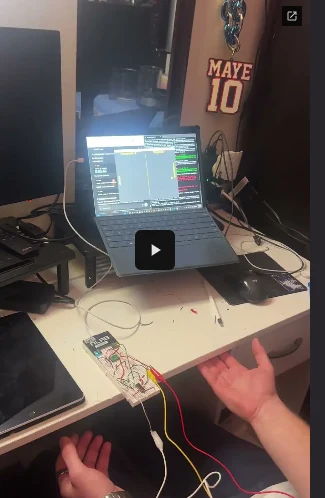
EMG-controlled Pong demonstration still
Playing single-player Pong by flexing and relaxing my biceps to control the paddle. Uneven movement likely reflects fluctuations in muscle activity and residual signal noise.
EMG circuit for Pong paddle control
EMG circuit that amplifies, filters, and rectifies muscle signals to control the Pong paddle.
04

Embedded systems · In development

Raspberry Pi LED Display & Home Control System

For this embedded systems project, I am developing a Raspberry Pi-based control system for a custom 6×2 HUB75 LED display and connected home devices. The system integrates LED matrix control, a touchscreen interface, Wi-Fi communication, and software for displaying live information such as sports scores, weather, time, and other configurable content. I am also designing the power distribution, panel communication, and user interface architecture to create a centralized home-control platform.

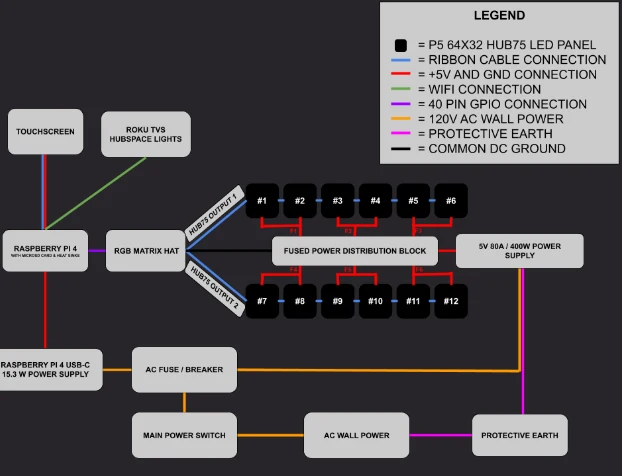
Raspberry Pi LED display and home control system architecture
System architecture for a Raspberry Pi-controlled 6×2 HUB75 LED display with touchscreen control, Wi-Fi integration, and fused power distribution.
Login